What Wood Types Are Used in Retail Displays?
Most retail display fixtures in Malaysia are built from plywood, MDF (medium-density fibreboard), pine, rubberwood or oak — the right choice depends on budget, load and finish. Plywood and rubberwood suit high-traffic shelving that needs structural strength, while MDF and pine work well for lighter, cost-conscious displays that get repainted or rebranded often.
What Is a Retail Display?
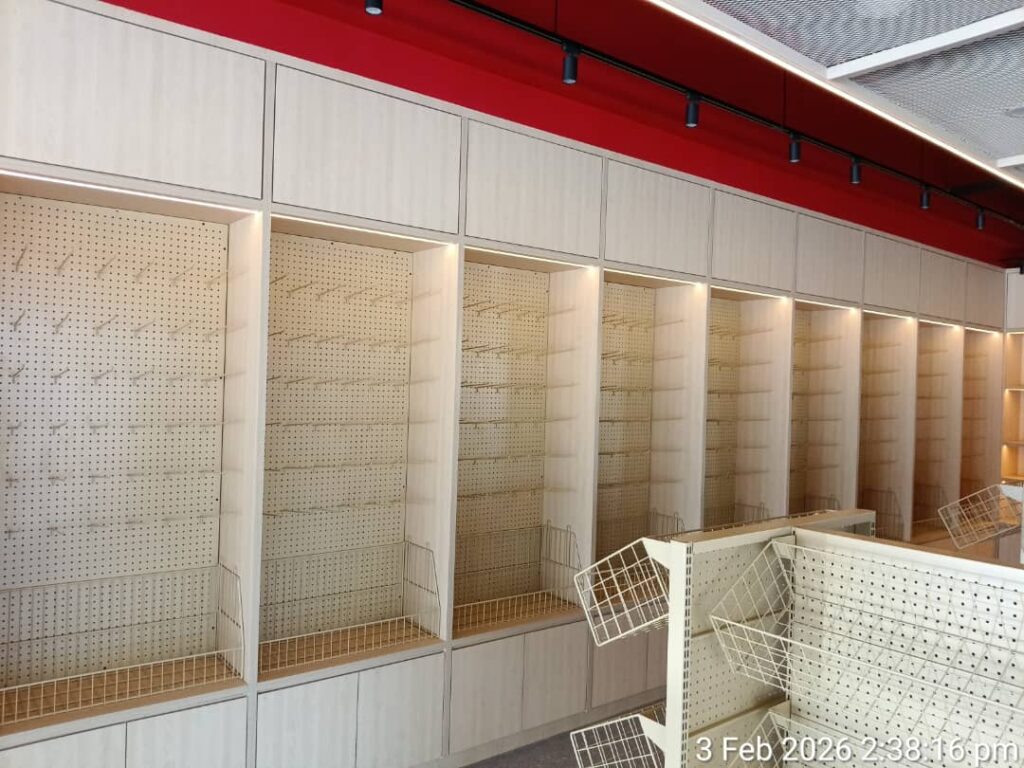
A retail display is any fixture — shelf, rack, counter or stand — used to present merchandise to shoppers on the sales floor. Retail displays range from simple wall-mount shelving to full gondola units, and the material they’re built from directly affects load capacity, lifespan, and how the finished display looks. Wood is one of three common structural choices for retail display fixtures, alongside steel and laminated MDF panels over a metal frame. Malaysian retailers typically choose wood for a warmer, boutique look — pharmacies, herbal stores, bakeries and specialty grocers use it most, while high-volume convenience stores tend to favour steel gondola racks for durability under constant restocking.
Solid Wood vs Engineered Wood: What's the Difference?
Solid wood — pine, oak, rubberwood — is cut directly from timber and has a natural grain running through the whole piece. It’s stronger under point load and can be sanded and refinished multiple times, but it costs more and can warp in humid conditions if not properly sealed.
Engineered wood — plywood and MDF — is manufactured by bonding wood fibres, particles or veneer layers under pressure. It’s more dimensionally stable in Malaysia’s humidity, cheaper per square foot, and easier to cut into consistent panels for mass-produced display units, but it has lower resistance to moisture at raw edges and cannot be refinished as many times as solid wood.
Wood Types Compared: Density, Cost and Best Use
| Wood Type | Density (kg/m³) | Relative Cost | Moisture Resistance | Best Use in Retail Display |
|---|---|---|---|---|
| Plywood (marine-grade) | 600–700 | Mid | High | Structural shelf carcasses, high-traffic units |
| MDF | 700–800 | Low | Low (raw edge) | Painted panels, signage boards, low-load fixtures |
| Pine (softwood) | 510–540 | Low | Low | Budget display stands, temporary/seasonal fixtures |
| Rubberwood | 560–640 | Mid | Medium | Countertops, shelf edges, mid-range display furniture |
| Oak (hardwood) | 700–770 | High | Medium–High | Premium boutique shelving, feature display counters |
Which Wood Type Is Best for High-Traffic Retail Displays?
For a retail display that gets restocked daily and handles constant customer contact — think a pharmacy counter or a bakery shelf — marine-grade plywood is the most common structural choice among Malaysian fixture makers. It carries higher point-load weight than MDF without the raw-edge swelling that MDF suffers in humid back-of-store storage areas.
Load-bearing shelving
Plywood shelf panels at 18–25 mm thickness typically support 15–25 kg per linear foot without sagging, depending on span length and bracket spacing. Spans over 90 cm should use a centre support bracket regardless of wood type.
Countertops and cashier surfaces
Rubberwood is the standard choice for retail display countertops that see daily handling — it resists scratching and dents better than pine, and it takes a smooth lacquer finish that survives repeated cleaning with retail-grade disinfectants.
How Much Does Wood Retail Display Furniture Cost in Malaysia?
Cost for a wood retail display unit depends on wood type, size, finish and whether it’s a stock design or a custom build. As a general guide: MDF-panel units run lowest, plywood-carcass units sit in the middle, and solid hardwood (oak, teak) units run highest — typically 2–3x the cost of an equivalent MDF unit for the same footprint. A 90 cm × 45 cm × 90 cm freestanding display table in painted MDF costs meaningfully less than the same design in solid rubberwood with a natural lacquer finish, mainly because of material cost per board foot and the extra labour solid wood requires for joinery and sanding.
Store owners budgeting for a retail display fit-out should also factor in finish: a sprayed lacquer or laminate top adds cost but extends the fixture’s working life in a high-touch retail environment by several years compared to an unsealed surface.
How Do You Maintain and Finish Wood Retail Displays?
A properly finished retail display should be resealed or repainted every 2–4 years in a Malaysian retail environment, where humidity and air-conditioning cycling stress wood joints faster than in drier climates.
Sealing and finishing
Lacquer and polyurethane sealants are the standard finish for retail display wood — they resist scuffing from trolleys and shopping baskets better than raw oil finishes. Raw or oiled edges on MDF panels should always be laminated or edge-banded, since MDF absorbs moisture fastest at cut edges.
Cleaning
Wood retail display surfaces should be wiped with a barely damp cloth, not soaked — standing water is the single most common cause of MDF panel swelling reported by Malaysian retail fixture technicians.
Which Wood Should You Choose? By Store Type
Pharmacy or clinic-adjacent retail
Rubberwood or oak shelving with a sealed lacquer finish — these stores need a display that reads as clean and durable under fluorescent lighting and frequent restocking.
Convenience store or minimart
Plywood-carcass shelving, often paired with steel gondola frames — cost and restocking speed matter more than a premium wood finish here.
Boutique, herbal store or specialty grocer
Solid oak or rubberwood with a visible wood-grain finish — the material itself is part of the brand’s warm, artisanal positioning.
Seasonal or promotional displays
Pine or MDF — lower cost makes sense for a fixture that will be replaced or repainted within a year.
Frequently Asked Questions
Is plywood or MDF better for retail display shelving? Plywood is generally better for structural, load-bearing retail display shelving because it holds screws and brackets more securely and resists humidity better than MDF. MDF is better suited to flat, low-load panels like signage boards or painted display fronts.
Does wood retail display furniture need to be fire-rated? Many Malaysian shopping malls require fire-rated (Class 1 or Class 0 spread-of-flame) finishes on retail display fixtures in common areas — check with the mall’s fit-out guidelines before finalising material and finish.
How long does a wood retail display unit last? A well-sealed plywood or rubberwood retail display unit typically lasts 5–8 years under normal retail traffic before needing refinishing or replacement; MDF units with painted finishes usually need replacement sooner, around 3–5 years.
Can wood retail displays be combined with metal gondola racking? Yes — a common approach in Malaysian minimarts and pharmacies is a steel gondola frame with wood-finish shelf panels or end-caps, which combines the load capacity of steel with the retail display appearance of wood.
Is rubberwood a sustainable choice for retail displays? Rubberwood is a widely available by-product of Malaysia’s rubber plantation industry, harvested after the trees stop producing latex, which makes it one of the more locally sourced wood options for retail display fixtures.
Bottom Line
Wood remains one of the most common materials for retail display fixtures in Malaysia, with plywood and rubberwood best for high-traffic, load-bearing shelving, and MDF or pine best for budget or short-lifespan displays. The right choice comes down to how much daily handling the fixture will see, the finish your store’s positioning calls for, and how long you need the unit to last before refinishing. Uniwell Malaysia Sdn Bhd works with retailers across these material choices when specifying and building custom fixtures.
Uniwell Retail Solution Sdn Bhd has manufactured gondola shelving, retail racking and cashier counters from its factory in Seri Kembangan, Selangor since 2003, supplying supermarkets, convenience stores, pharmacies and petrol retail across Malaysia.